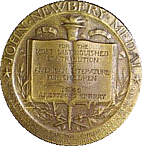
2008 Newbery and Caldecott Medal Winners

I’m a kid’s lit enthusiast, but an amateur one. That’s why my post about the 2008 ALA awards is over a month late. I wanted to give myself time to read a few more of the winners and honors before I posted. I read most of the books after they were announced, and I still have not read some of them. I’m in awe of the many kid’s lit superstars, who not only read most of the books before the winners are announced, but predicted many of the winners as well. The ALA awards are different from other book awards in that there’s no short list or list of nominations announced, so it’s a complete surprise the Monday morning when it’s announced.

2008 Newbery Medal Winner:
Good Masters! Sweet Ladies! Notes from a Medieval Village by Laura Amy Schlitz

2008 Newbery Honor Books:
Elijah of Buxton by Christopher Paul Curtis
The Wednesday Wars by Gary D. Schmidt
Feathers by Jacqueline Woodson

The 2008 Newbery and Me:
I read Good Masters! Sweet Ladies! right after it won (I’m a master of my library’s reserve system). I had no idea what to expect, but I loved it. It’s a collection of monologues from the point of view of different children in a Medieval Village. I imagine this will be a great book for teachers to use in their classroom, but it’s very enjoyable to just sit down and read on your own as well. I read several of the poems out loud to myself because they were so charming and had such a nice rhythm. I learned a lot about Medieval times while reading the book too, it’s not just for kids.

I read The Wednesday Wars after that, and fell head over heels for it. It completely transported back to the time when I was young and could absolutely not move until I finished a good book. Before there were so many little things to do or check on that required putting a bookmark in and pausing the story for a while. Holling Hoodhood is now one of my favorite characters in children’s literature. I wrote a little more about the plot of the book in a previous post, so I won’t go on about it here.

I have not read Elijah of Buxton or Feathers yet, but I have them on reserve from the library. I’ve read Christopher Paul Curtis’s other Newbery winner, Bud, Not Buddy, which is delightful. I have high hopes that Elijah will be as endearing as Bud is.

2008 Caldecott Winner:
The Invention of Hugo Cabret written and illustrated by Brian Selznick

2008 Caldecott Honor Books:
Henry’s Freedom Box: A True Story from the Underground Railroad by Ellen Levine, illustrated by Kadir Nelson
First the Egg written and illustrated by Laura Vaccaro Seeger
The Wall: Growing Up Behind the Iron Curtain written and illustrated by Peter Sis
Knuffle Bunny Too: A Case of Mistaken Identity written and illustrated by Mo Willems

The 2008 Caldecott and Me:
I read The Invention of Hugo Cabret shortly after it was released last year. I became a big fan and followed all the speculation about whether or not it could be a contender for either award. Because of its incredibly unique format, many thought it would not fit into either major award category. I loved the way the pictures intertwined with the novel and how turning the pages was like a camera zooming in on what we’re supposed to look at. Hopefully this work will be a bit of a groundbreaker and will encourage others to try new things with pictures and illustrations too. We live in a very visual world, and illustrations in books should not be confined to just traditional picture books or graphic novels. I wish more illustrations were used in books for adults. This Caldecott Medal was extremely well deserved.

I read Knuffle Bunny, Too last year as well. Actually, I read it and then Mo Willems read it to me! I love Mo Willems, and boy do kids ever love him too. The illustrations in both Knuffle Bunny books are unusual too, Mo takes photographs of the setting (Brooklyn) and then draws on top of them. You have to look at them for a while before you realize how unique they really are. I read KB1 and KB2 aloud to my brother’s first grade class when I was the mystery reader last year. The kid’s loved it, and after I finished reading the second one they asked me if there was a third one I could read to them. I promised to come back and read the third as soon as Mo writes it.

Everytime I saw The Wall at a bookstore last year I picked it up and looked at it and wanted to buy it. A lot of times with picture books I’ll just stand there in the store and read it to decide if I want to buy it, but The Wall is too detailed and deep for a quick bookstore reading. After it received the honor medal I went to the library and took it out, and sat down and read it one evening. I wrote a bit of a description of it in this post (the same as The Wednesday Wars post). After reading the library’s copy, it went straight on my Amazon wish list to buy soon for my own collection.

I have not read First the Egg or Henry’s Freedom Box yet, but I have my eyes open for them at the library and at bookstores.

(This post was brought over from emilyw.vox.com. Click here for the original post and comments.)

posted by chowmeyow in bookish things and has Comments Off

Top Five: Caldecott Books

Last summer I completed my quest of reading all 69 Caldecott Medal winners. Since then, one of my favorite children’s book authors and illustrators, David Wiesner, won the 2007 Caldecott Medal for Flotsam.

The Caldecott Medal is primarily recognition for outstanding art and illustrations, though how these illustrations work with the text of the book is a factor in its excellence. In my own list of favorites, text plays heavily into how much I like the book – almost equal in importance. Thus my list is more of a list of my picks for all around brilliance and personal all time favorites out of the 70 Medal winners.

1. Where the Wild Things Are written and illustrated by Maurice Sendak. (1964 Medal)
This is one of the most beloved children’s books of all time, and holds top spot in my heart as well. Every word, picture, and detail is imaginative and perfect.

2. Many Moons written by James Thurber and illustrated by Louis Slobodkin. (1944 Medal)
James Thurber is just as brilliant and funny while telling a children’s story. Slobodkin’s pen and color illustrations are squiggly and charming. I have no idea why someone felt the need to release a later version with different illustrations. Why redo a Caldecott winner? This is the story of a Princess named Lenore who is sick and wants the moon to make her feel well again. The story is hilarious, and the moral is wise: perspective is everything.

3. May I Bring a Friend? written by Beatrice Schenk de Regniers and illustrated by Beni Montresor. (1965 Medal)
This is a cute story of a king and queen who are friends with a small boy and invite him to meals. The boy always asks if he can bring a friend. The answer is always yes, even though he keeps bringing zoo animals as his guests! The illustrations are grand and expressive – they do a great job showing how over the top and funny it is to have animals at the dinner table.

4. Fables written and illustrated by Arnold Lobel. (1981 Medal)
I love Arnold Lobel (the imagination behind Frog and Toad), and this book is my favorite of his. Each spread is a different fable, one side for the story, and one side for the accompanying illustration. The fables are funny and creative, and they each have a fitting moral at the end. The illustrations are of the same beautiful style as the Frog and Toad books.

5. Song and Dance Man written by Karen Ackerman and illustrated by Stephen Gammell. (1989 Medal)
This is a beautifully sweet story of a grandfather revisiting his youthful days to people who appreciate it as if it were new: his grandchildren. Grandpa was a vaudeville song and dance man, and revives his music and jokes to entertain his loving audience of three. The illustrations are gorgeous and creative, with lots of bright colors.

Song and Dance Man Fables Many Moons May I Bring a Friend? Where the Wild Things Are


I haven’t read all the Caldecott Honor books yet (there are 221) but here is my Top Five so far:

1. Sector 7 written and illustrated by David Wiesner (2000 Honor)
2. Zen Shorts written and illustrated by Jon J. Muth (2006 Honor)
3. What Do You Say, Dear? written by Sesyle Joslin and illustrated by Maurice Sendak (1959 Honor)
4. Peppe the Lamplighter written by Elisa Barton and illustrated by Ted Lewin (1994 Honor)
5. Lion written and illustrated by William Pene de Bois (1957 Honor)

Zen Shorts (Caldecott Honor Book) Sector 7 (Caldecott Honor Book) Peppe the Lamplighter What Do You Say, Dear? Lion
(This post was brought over from emilyw.vox.com. Click here for the original post and comments.)

posted by chowmeyow in top five and has Comments Off